Why the trade did not go through
Two traders can press the same button, on the same token, in the same second, and end up with different prices — or with no trade at all. The gap between them is execution, and most of it is made of settings chosen earlier.
What the button actually sends
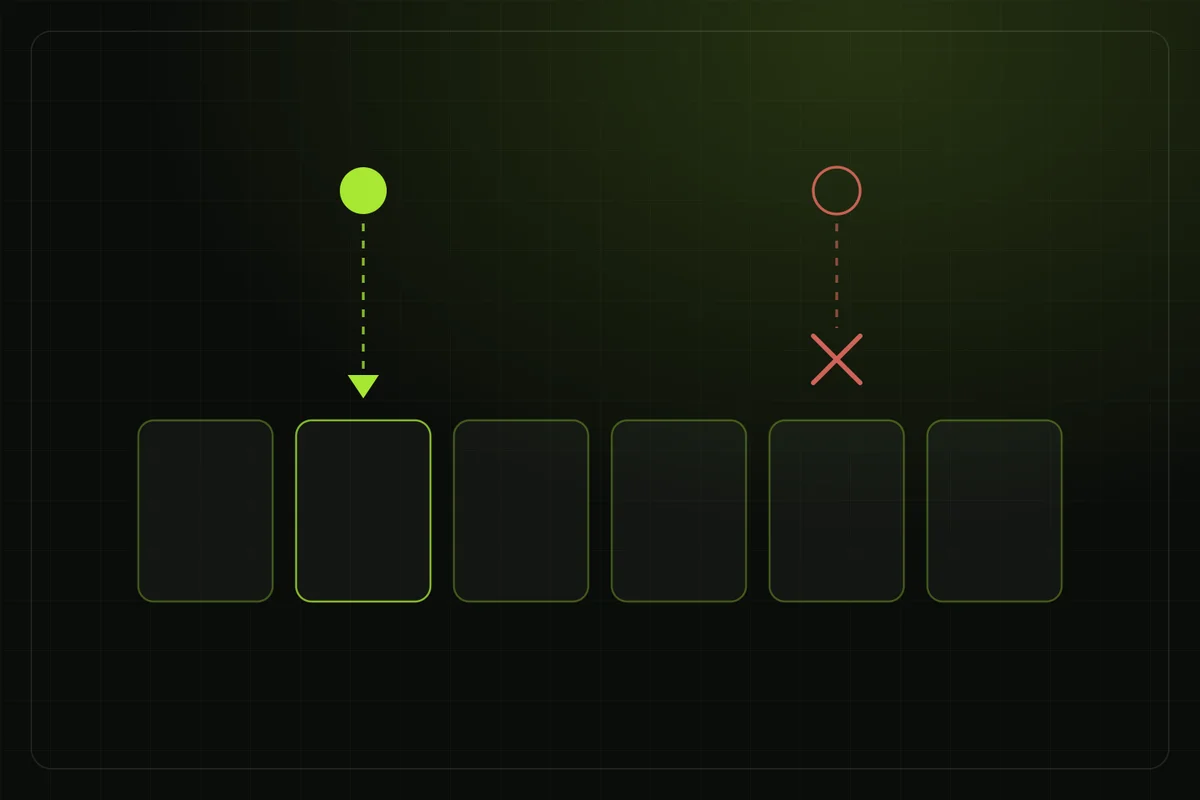
Your click becomes a transaction with an amount, a route through a pool, a limit on how far the price may move, and a fee that competes for a place in the next block. It either lands inside that block or it does not exist.
Nothing about it is instant, and nothing about it is guaranteed. The screen is showing you a quote from the recent past, while the transaction is competing for a slot in the near future.
Slippage is a budget, not a safety net
Slippage toleranceSlippageThe gap between the price you saw and the price you got — and the tolerance you set for that gap before the order is rejected. is the worst price you agree to accept. Set it too tight on a moving token and the transaction fails; set it wide and you have published how much a SandwichSandwichA bot buys immediately before your order and sells immediately after it, keeping the price it pushed you into. bot may take from you.
It is also not the same thing as Price impactPrice impactHow far your own order moves the price, decided by order size against pool depth.. Impact is what your own order size does to the price, and no tolerance setting removes it — on a thin pool a large order is expensive even with a perfect fill.
Tolerance covers movement between quote and fill. It never covers the cost of your own size.
Fees buy time, not certainty
A Priority feePriority feeAn extra fee that buys your transaction a better place in the queue when the network is busy. raises your place in the queue when blocks are full, and a TipTipA payment to a block-building service — Jito on Solana — for faster or bundled inclusion. pays a block builder for faster or bundled inclusion. Both are the price of being on time, which is a different thing from being right.
Terminal fees, protocol fees, priority fees, tips and slippage all come out of the same trade. Add them up once for a typical position: on small sizes they decide where BreakevenBreakevenThe price at which a position returns exactly what it cost, fees included. actually sits.
When a failure means something
Ordinary failuresFailed transactionA transaction that did not execute because slippage, fees or liquidity moved before it landed. are noise: the price moved, the fee was low, the route changed. You pay the network fee and try again with a wider setting.
A pattern is different information. When buys land and sells do not, the token is answering a question you should have asked before entering.
Stop and look when
- Buys land and sells keep failing
- The failure survives a higher slippage and a higher fee
- A simulation returns an amount that does not match the quote
- Only your sells fail while the trades tab keeps filling
You do not control the price. You control the settings.
Terms from this guide
- Slippage
- The gap between the price you saw and the price you got — and the tolerance you set for that gap before the order is rejected.
- Price impact
- How far your own order moves the price, decided by order size against pool depth.
- Priority fee
- An extra fee that buys your transaction a better place in the queue when the network is busy.
- Tip
- A payment to a block-building service — Jito on Solana — for faster or bundled inclusion.
- Sandwich
- A bot buys immediately before your order and sells immediately after it, keeping the price it pushed you into.
- Failed transaction
- A transaction that did not execute because slippage, fees or liquidity moved before it landed.
- Preset
- A saved set of order settings — size, slippage, priority fee — bound to one button.